How to Study With AI
Ethically — and in a way that works
AI will write your essay in nine seconds. It will not sit your exam in January. Every method, every prompt, and the reasoning behind each one — worked through a single example from first research to final paper.
Download the companion PDF36-page PDF · every prompt, every method · no email required
Two ideas hold this together.
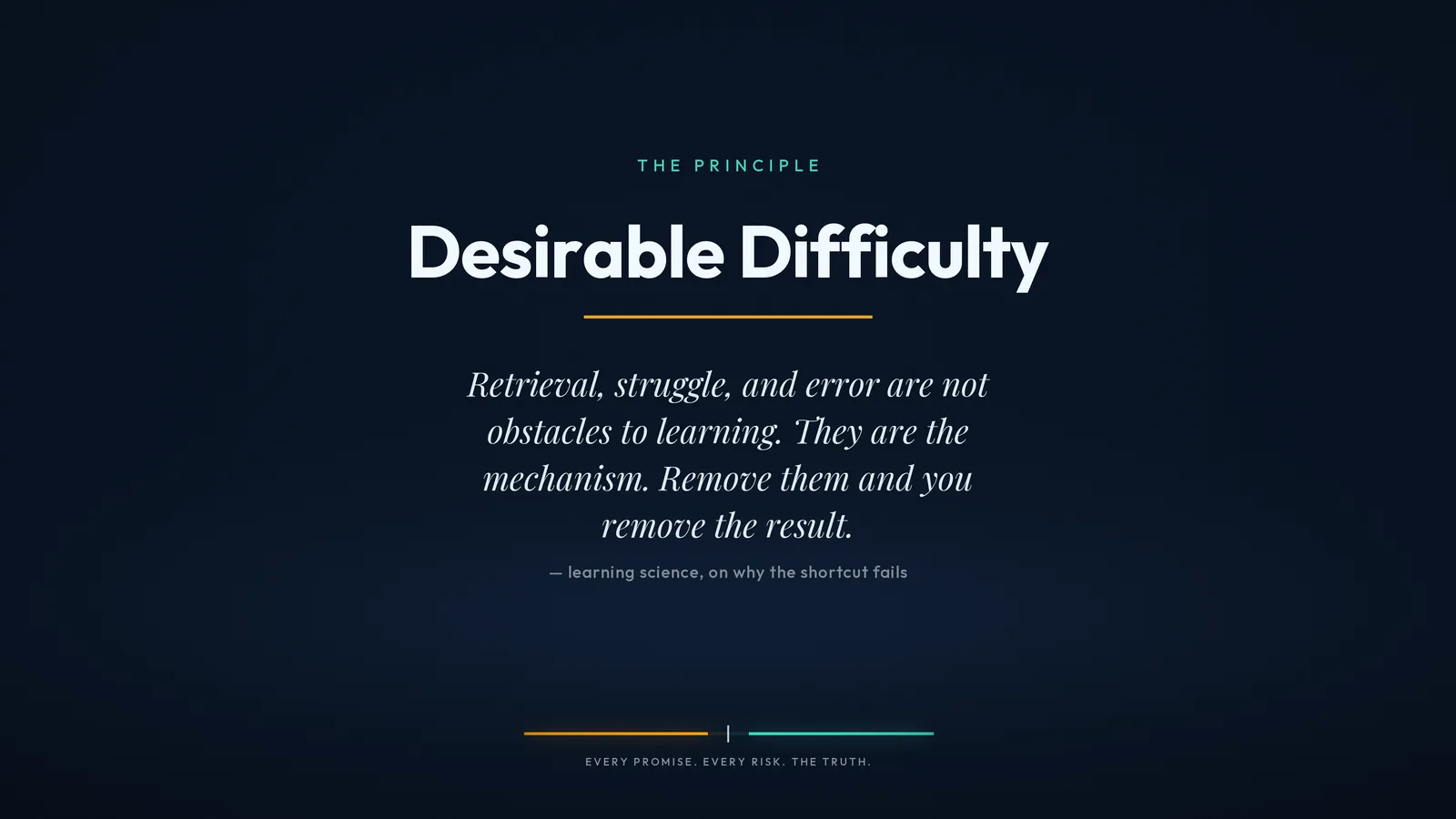
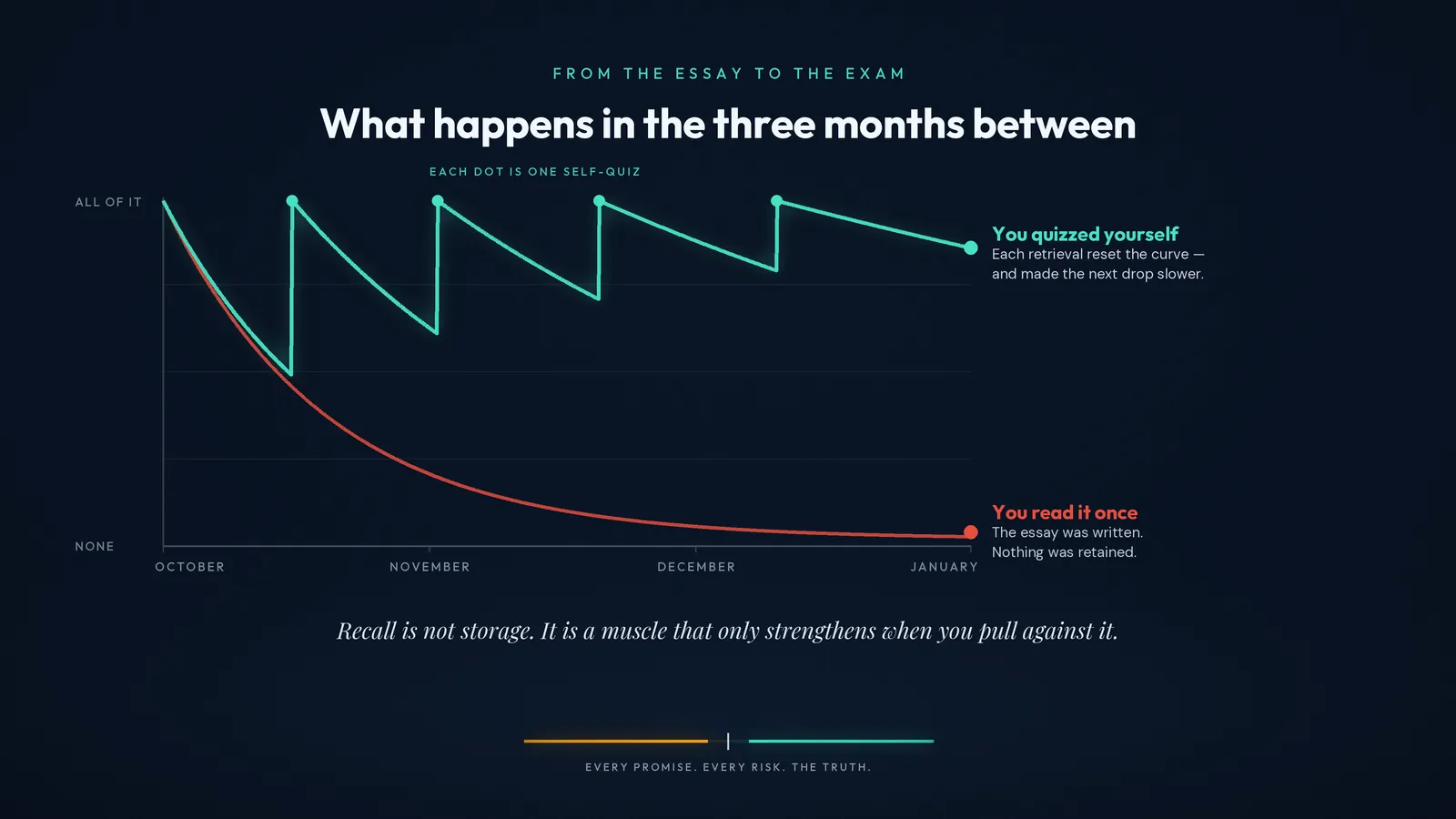
The first is a principle from learning research. Retrieval, struggle and error are not obstacles to learning. They are the mechanism. Remove them and you remove the result.
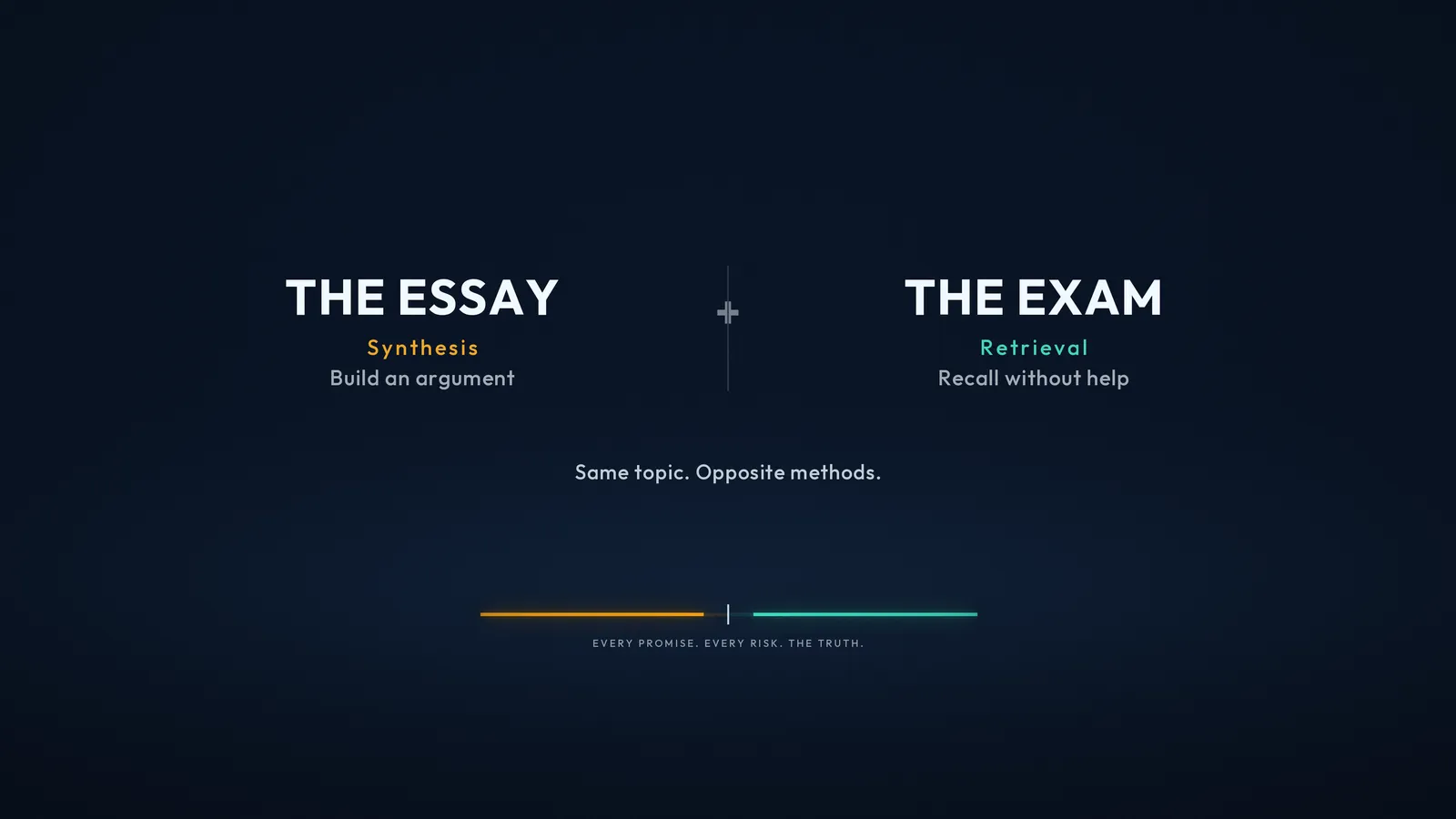
The second is structural. One topic, two very different tasks.
The essay is a synthesis task. It asks you to build an argument and defend it. The exam is a retrieval task. It asks whether you can produce the sequence, the dates and the names without help.
Those two tasks need opposite things from AI. Most students use the same prompt for both, and it fails at both.
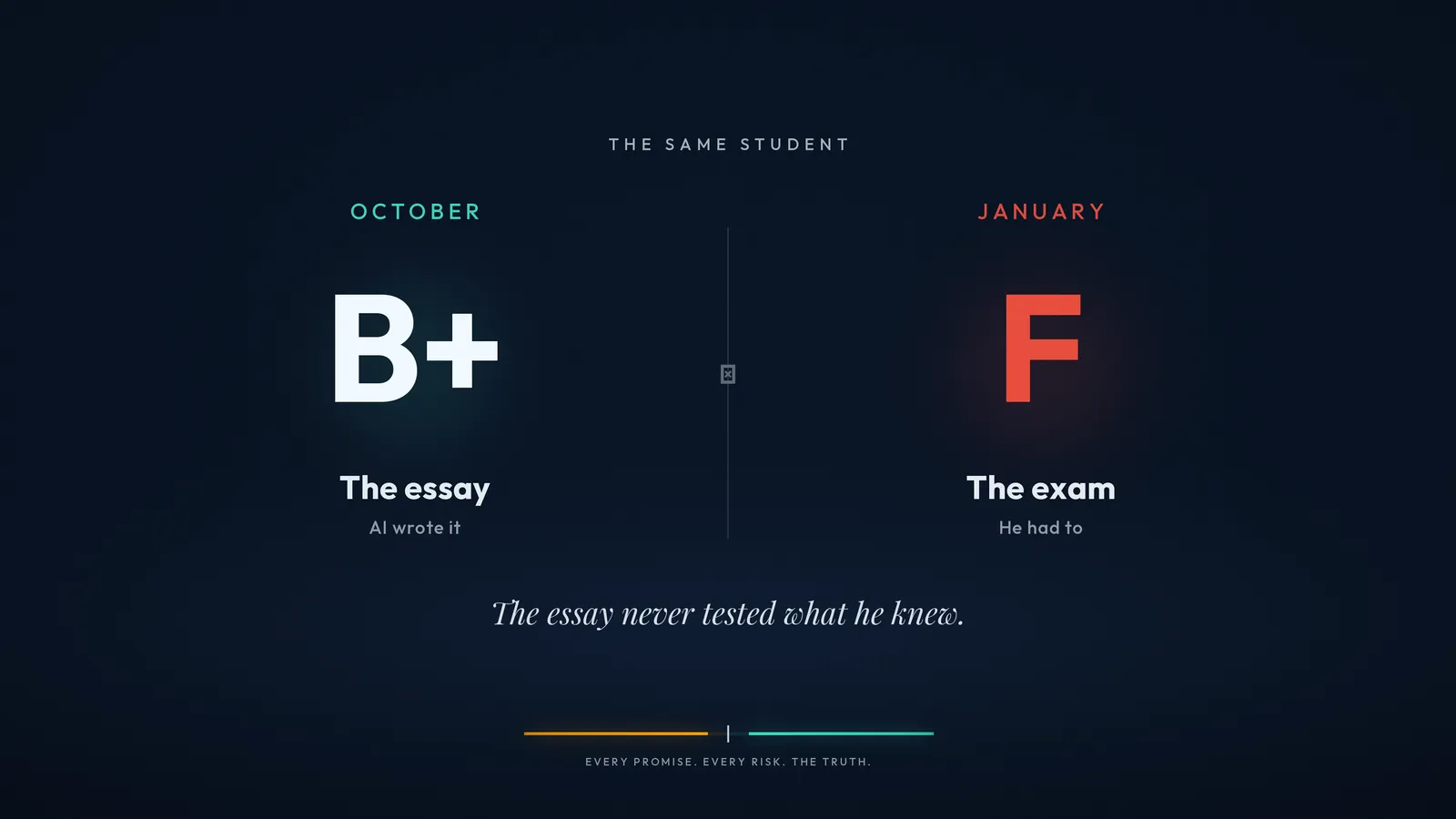
Everything below is worked on one example: an essay on the causes of the First World War in October, and a final exam on the same topic in January.
Why the shortcut fails
The default prompt produces a finished essay and a student who cannot answer a single question about it three months later.
The essay gets a grade in October. The exam arrives in January and asks what you actually know.
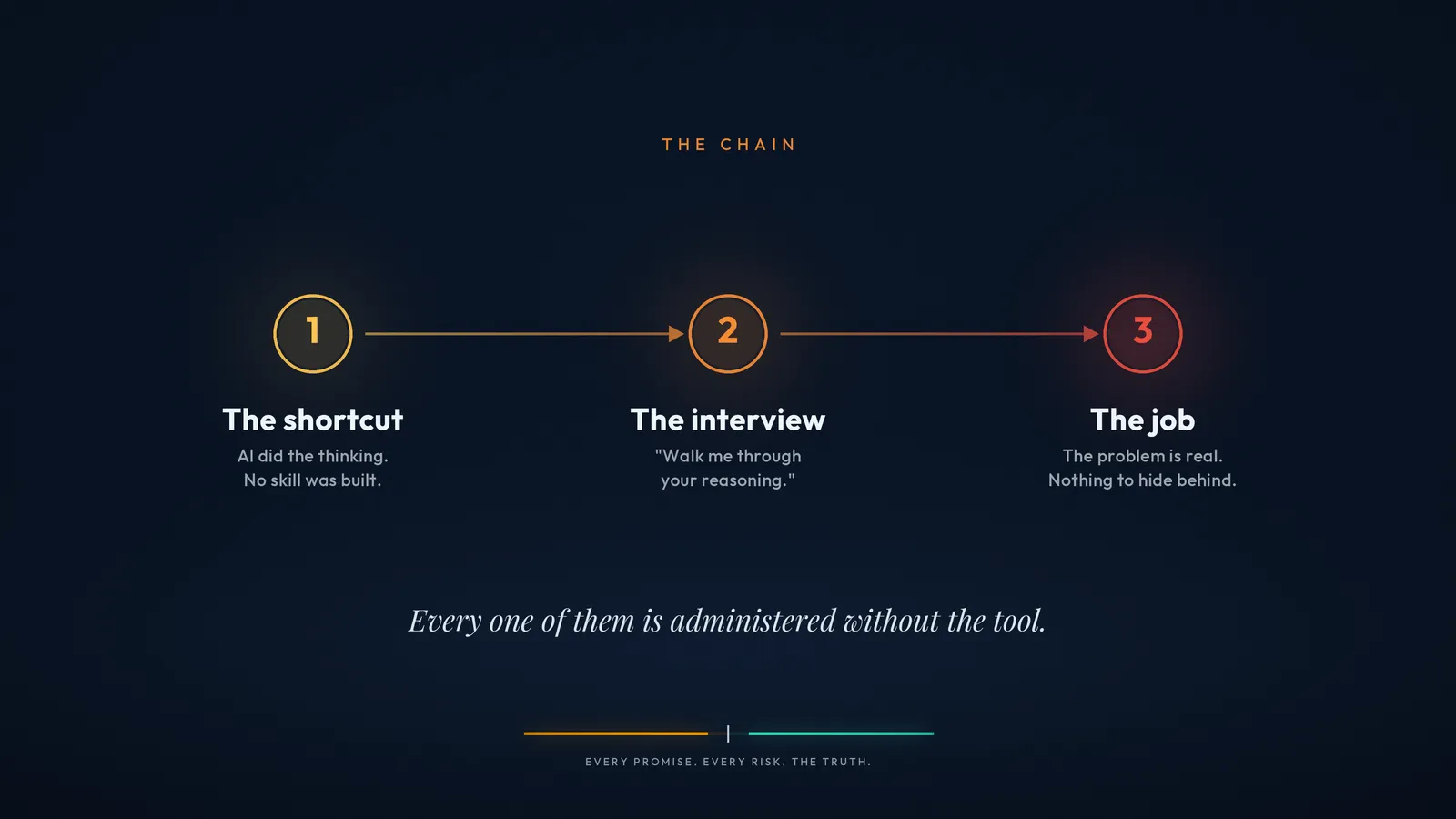
And the consequences do not stop at the exam. Every one of the things that comes after is administered without the tool.
1 · Read the rules before you type anything
There is no universal rule. The policy that governs you is set by your institution, and often by your faculty or your individual instructor on a specific assignment. The most specific rule wins.
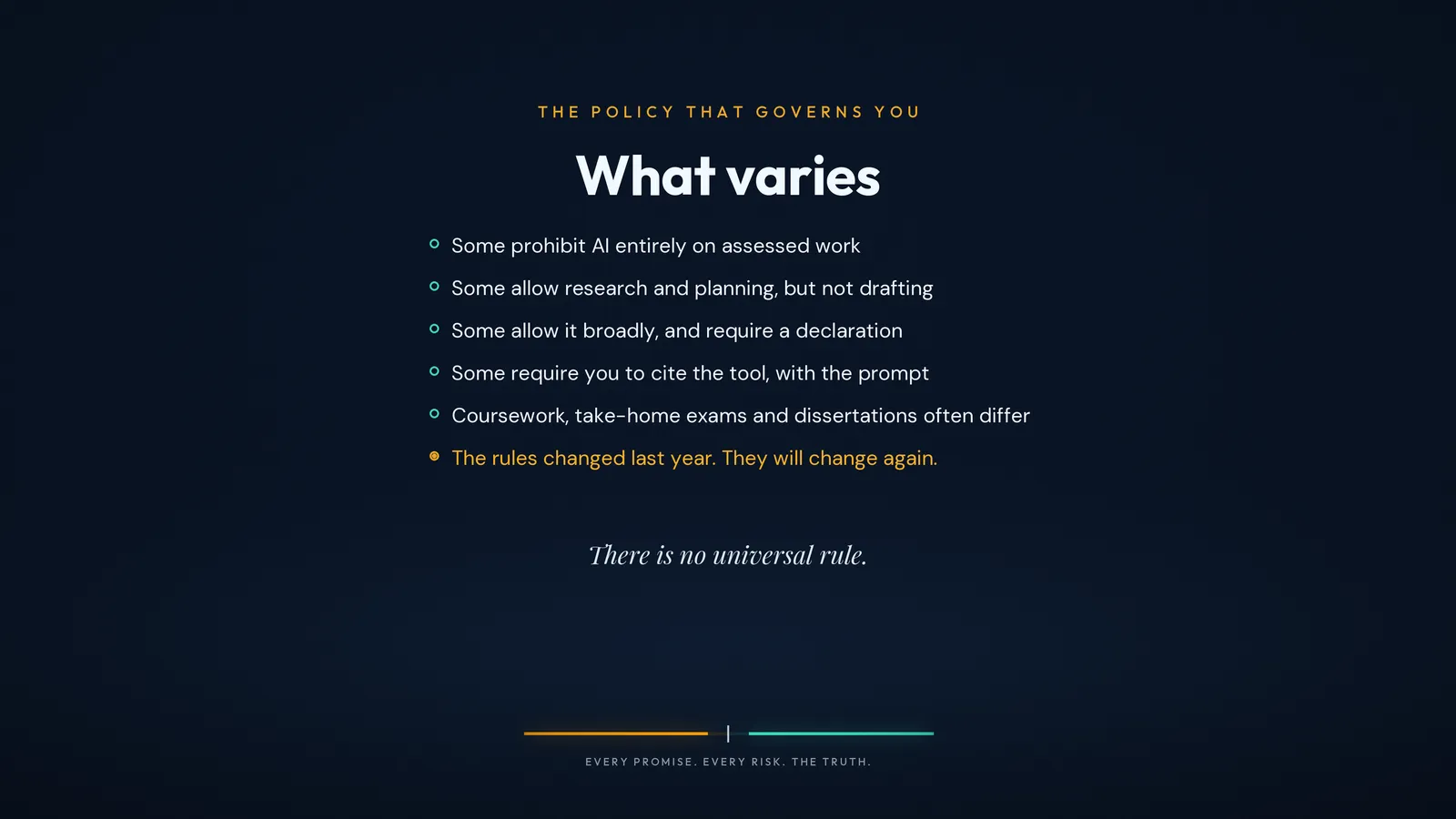
Three things to do before term starts: find the policy, read the assignment brief for anything that overrides it, and load both into the tool you are going to use.
I'm pasting my institution's academic integrity policy on AI use. Remember it for everything we do this term. Before you answer any request from me, check it against this policy. If what I've asked for would breach it, tell me which section and stop.
This is a seatbelt, not a compliance guarantee. The model can misread the policy, forget it in a long session, or apply it inconsistently. You remain accountable for what you submit. It reduces accidental drift. It does not transfer responsibility.
2 · Research, done honestly
Use AI to find the conversation. Never to replace reading it.
I'm writing an undergraduate essay on [topic]. Don't tell me the answer. Tell me what the major disagreements are, so I know what argument I'm walking into. For each school of interpretation, name the person most associated with it and the work I should read to check it myself.
A student who knows what the specialists argue about is writing a real essay. A student who lists the four textbook causes is writing a summary.
For each source you just gave me, list only the author, the exact title, the publisher or journal, the year, and the ISBN or DOI. No description, no summary. I'm going to check every one of these in my library catalogue.
AI generates citations that look exactly right — plausible author, plausible title, plausible year — for works that do not exist. The formatting is perfect because formatting is a pattern. Existence is not a pattern.
Then you read. This is the part that cannot be delegated, and the part where the essay is actually won.
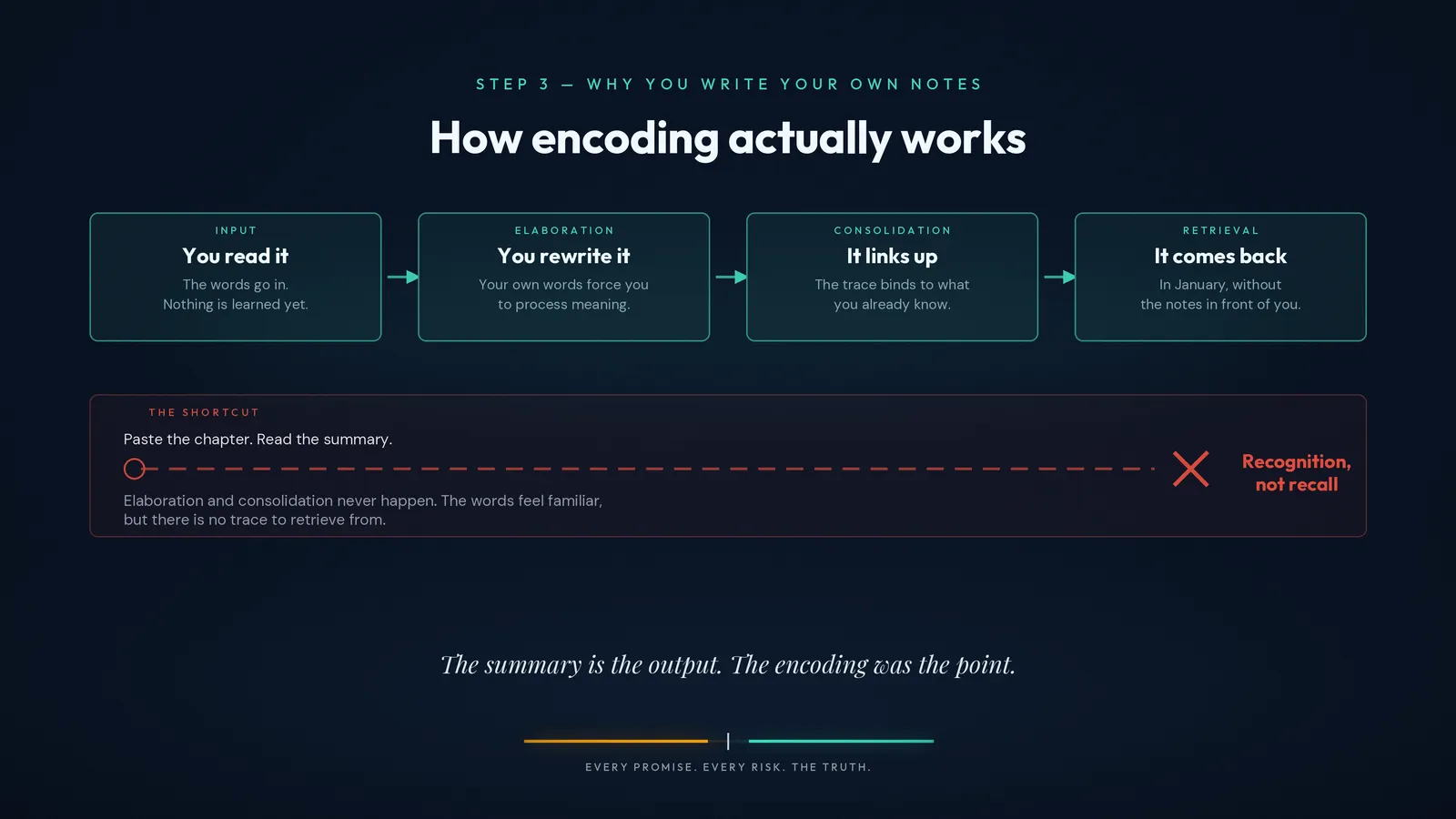
Here are my notes on [author]'s argument, in my words. I'm not asking you to improve them. Tell me what I've misunderstood, and what a specialist would say I've left out.
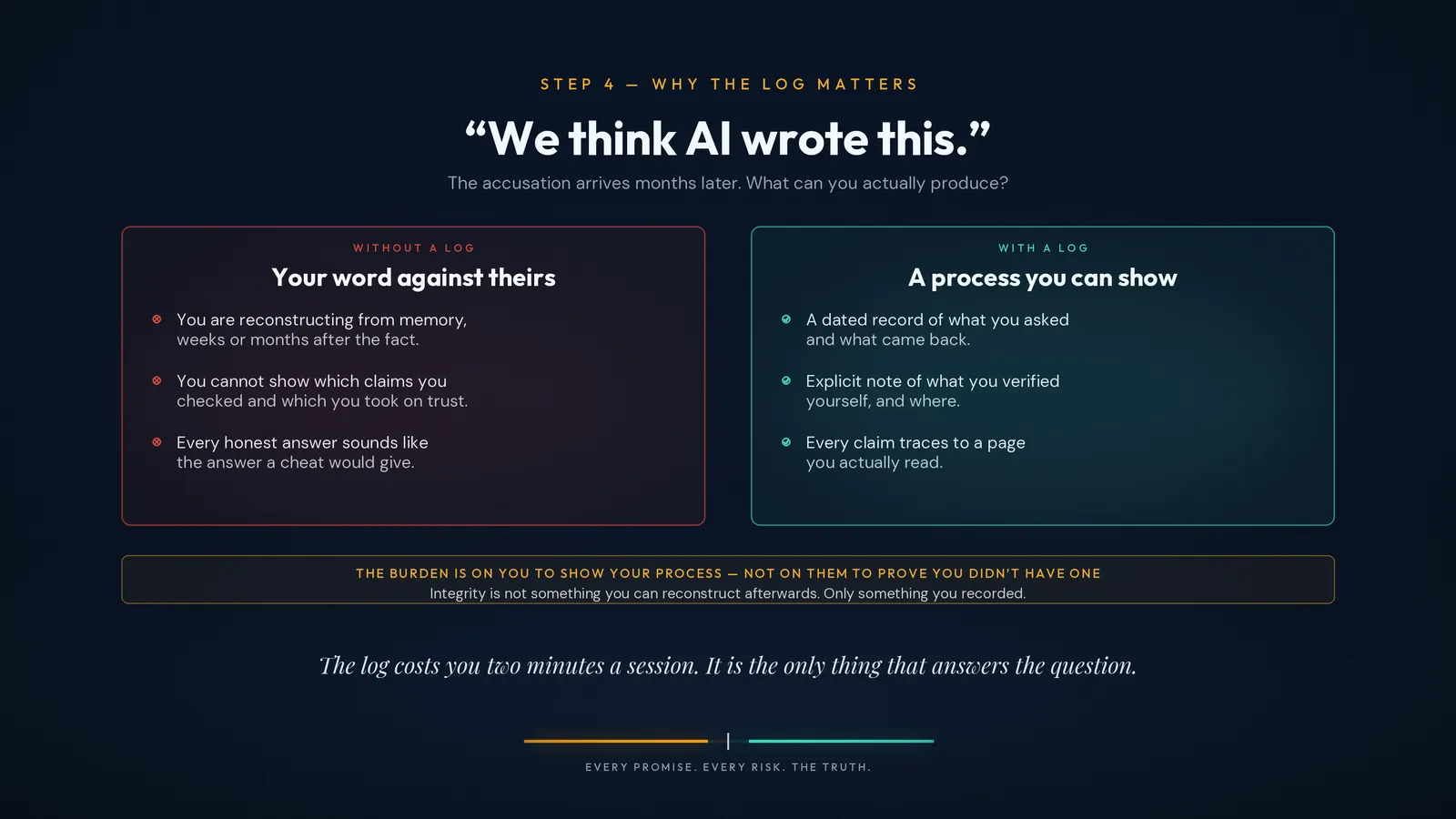
Summarize everything I've used you for in this conversation: what I asked, what you produced, and what I said I would verify myself. Format it as a dated log I can attach to my assignment as an AI-use declaration.
3 · The essay — build an argument you can defend
AI’s job here is adversarial, never generative.
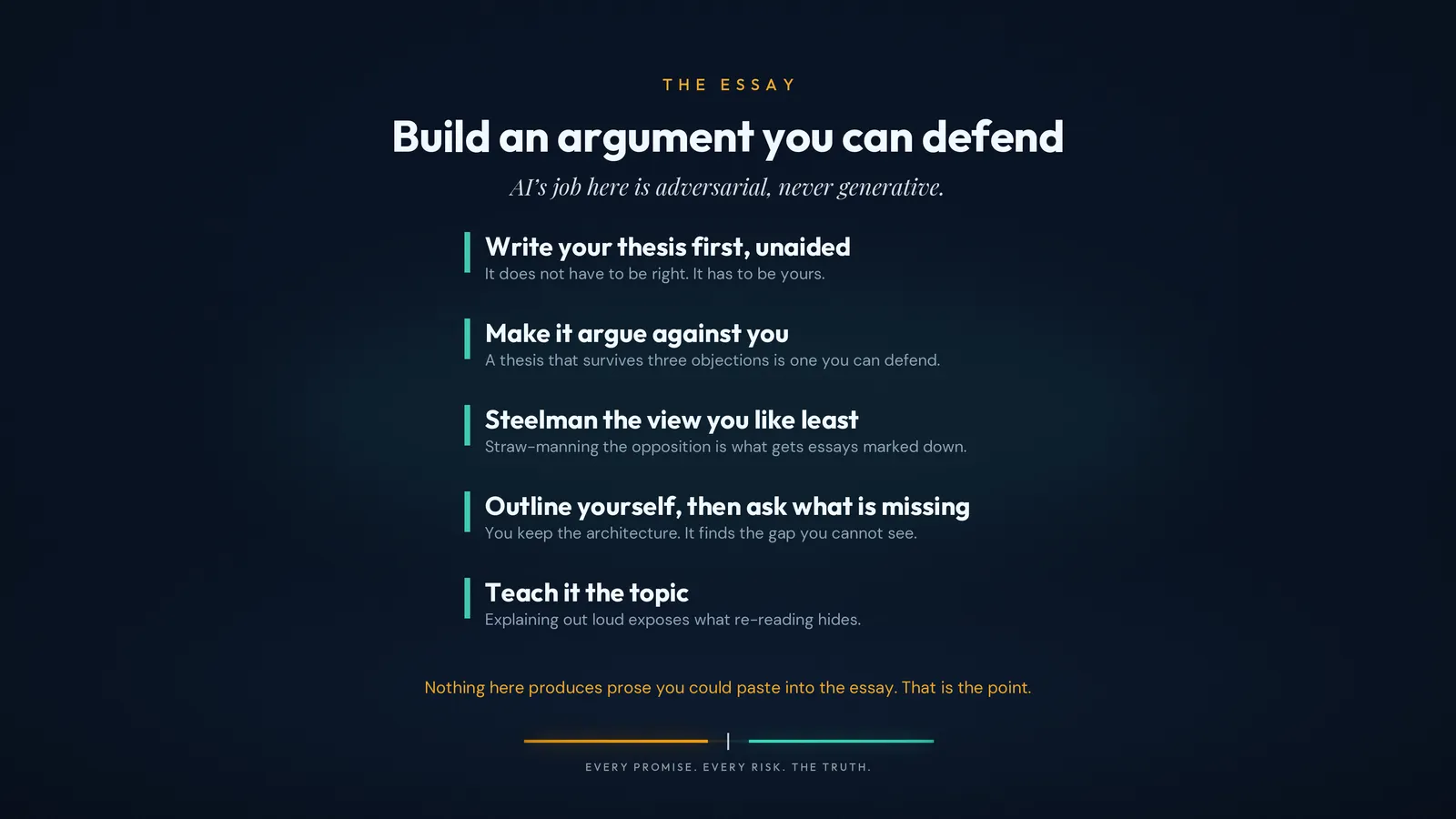
Write your thesis first, unaided
There is no prompt for this one. The blank page is the method.
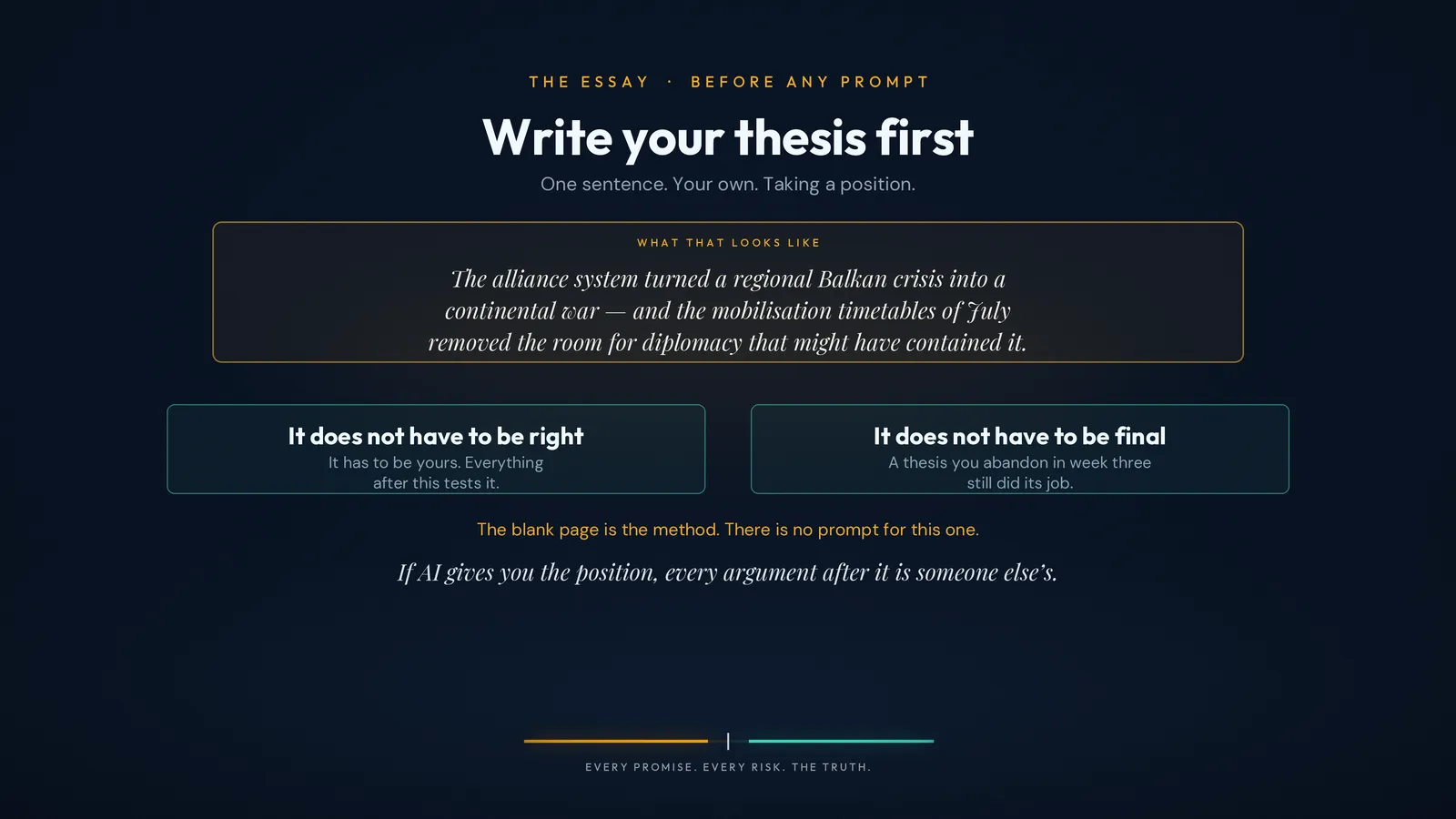
Then make it attack.
Here is my thesis: [paste your sentence]. You are an examiner who disagrees with it. Give me the three strongest objections, and name the evidence each one rests on.
Make the strongest possible case for [the interpretation you find least convincing], stronger than I could make it. Then make the strongest case against that view. Don't tell me which is right.
This is my essay structure. Don't rewrite it. Tell me where the argument jumps, which claim I haven't evidenced, and what a marker would push back on.
You're a student who hasn't studied this. I'm going to explain [topic]. Interrupt whenever I'm vague or skip a step, and ask the question a confused person would ask.
Nothing in this section produces prose you could paste into the essay. That is deliberate, and it is what makes the method defensible under the strictest policy.
4 · Formatting — the one job it is built for
Everywhere else in this guide the model’s mechanism is a liability. It predicts what an answer looks like rather than retrieving what is true. Formatting is the one task where that mechanism is exactly right, because a citation style is a pattern.
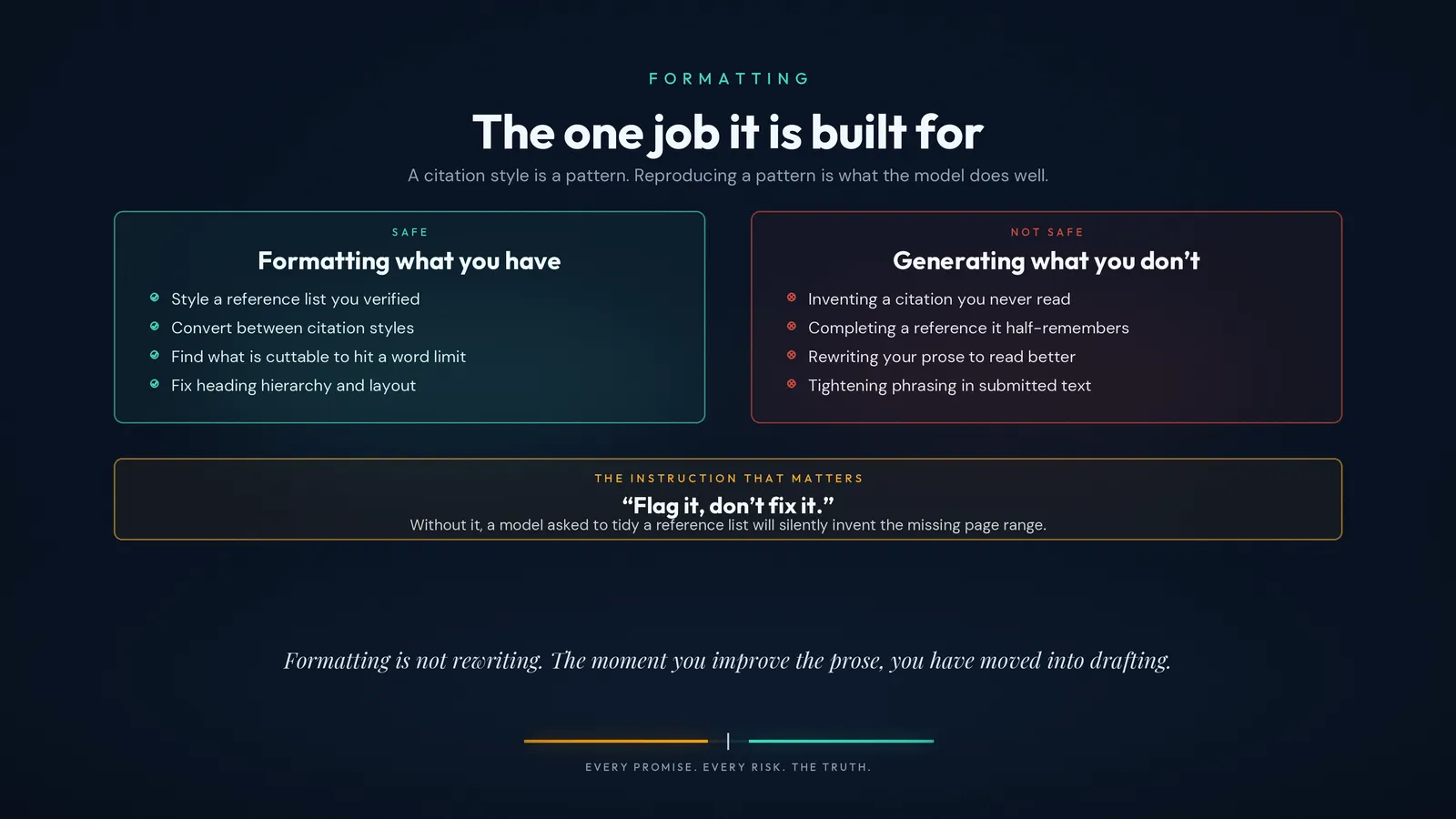
Here are my [n] references. I have verified that every one of them exists and I have read them. Format them as an [APA 7th / Chicago notes-bibliography / OSCOLA] reference list, alphabetized. Do not add any sources. Do not correct or complete any details — if something looks wrong or incomplete, flag it and leave it as it is.
The “flag it, don’t fix it” instruction is the part that matters. Without it, a model asked to tidy a reference list will silently invent a missing page range to make the entry look complete.
Convert these footnotes from [style A] to [style B]. Don't change the content of any note, only the format.
My essay is [n] words and the limit is [n]. Show me which passages could go without losing any part of the argument. Don't rewrite anything and don't delete anything — point at what is cuttable and tell me what each cut would cost.
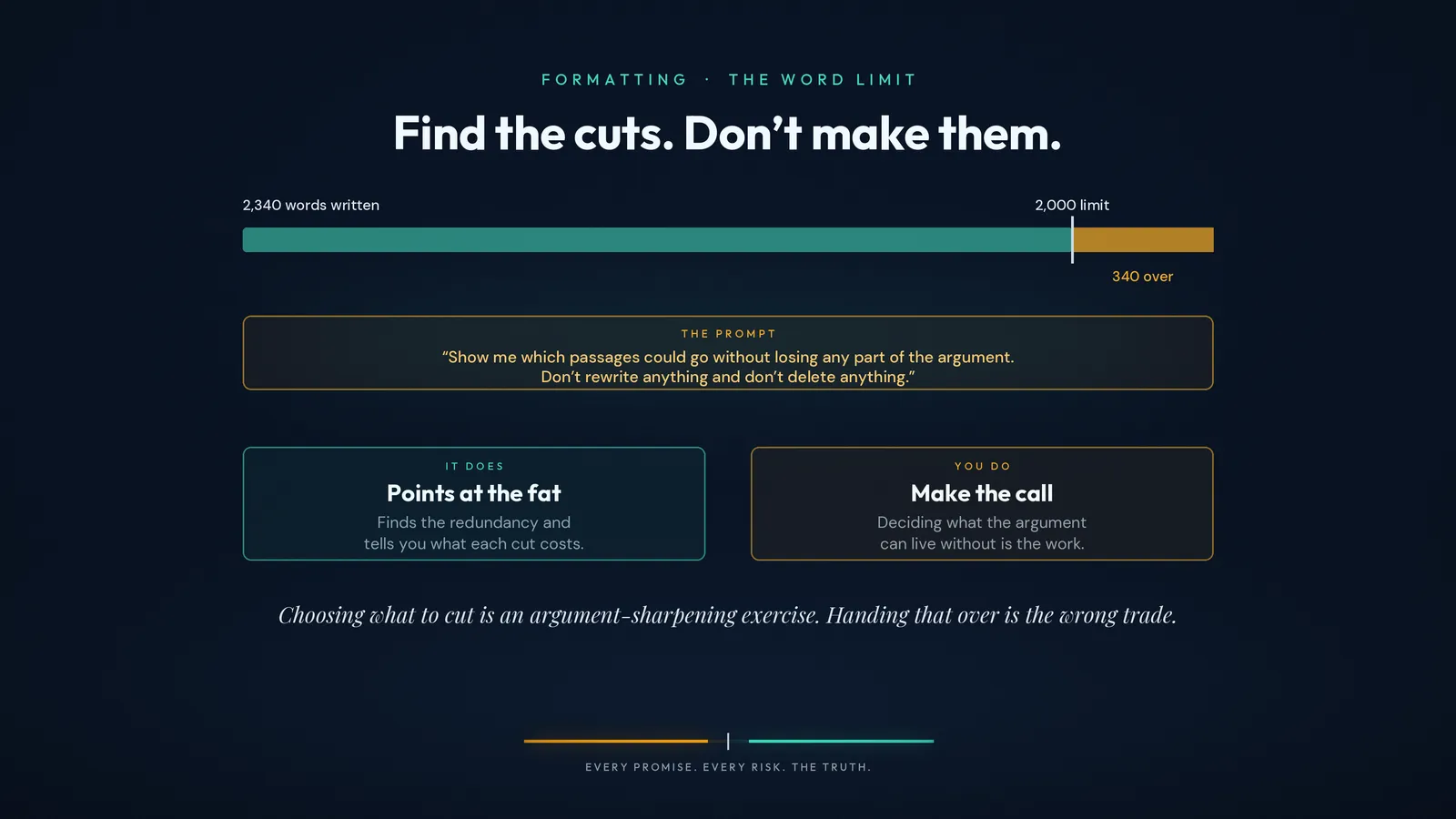
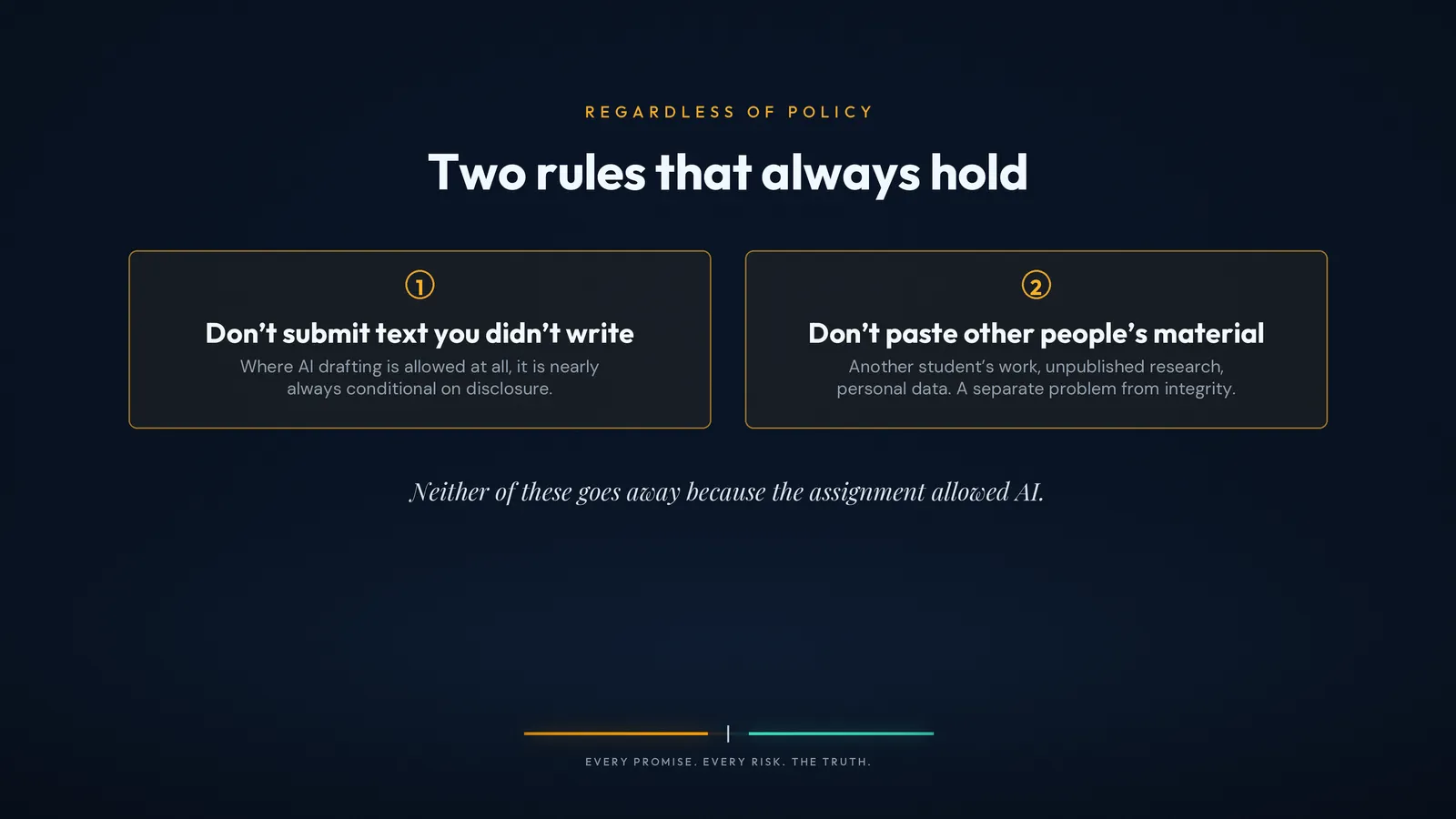
Formatting is not rewriting. The moment you ask it to improve the prose, you have moved into drafting, and drafting is the thing your institution has an opinion about.
5 · The exam — build recall that survives January
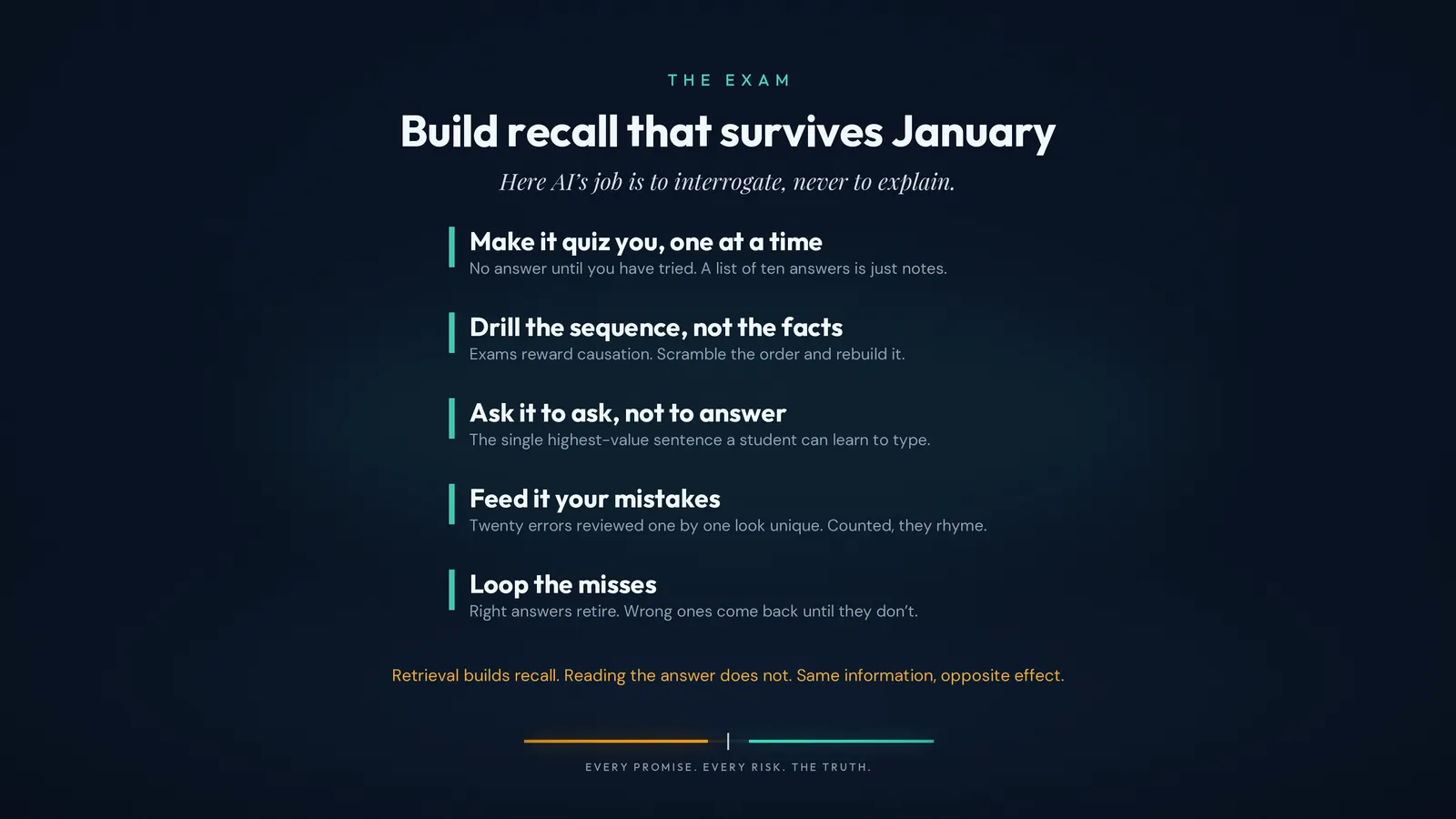
Here AI’s job is to interrogate, never to explain.
Make it quiz you
Here are my notes on [topic]. Ask me ten questions, one at a time. Don't give me the answer until I've tried. After each answer, tell me what I got wrong and why. Then ask the next one.
The one-at-a-time constraint matters. A list of ten questions and answers is just a page of notes.
Drill the sequence, not the facts
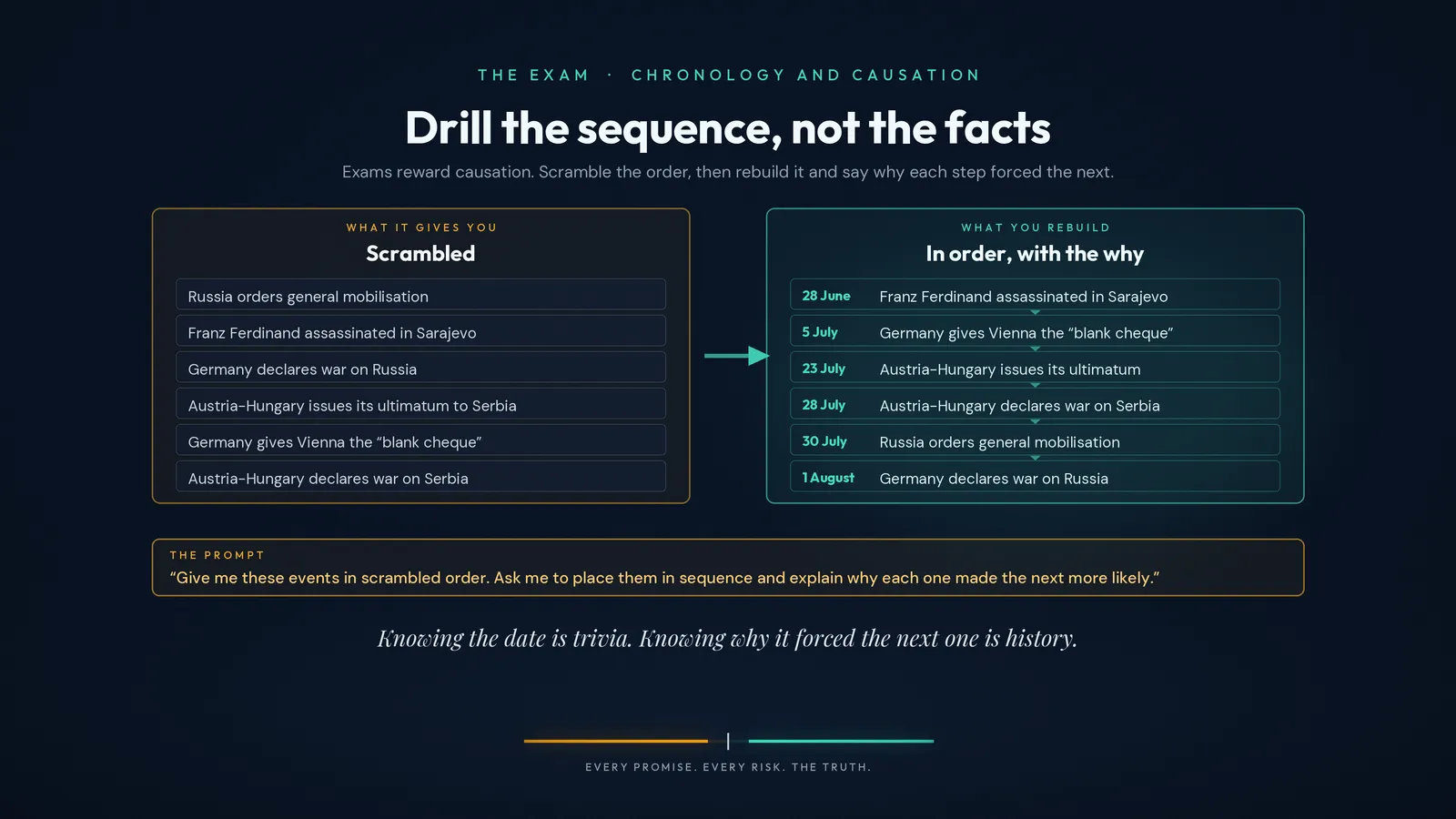
Give me the events of [sequence] in scrambled order. Ask me to place them in sequence and explain why each one made the next more likely. Don't confirm anything until I've committed to the full order.
Ask it to ask
Don't answer this. Ask me questions that help me work it out myself. Only tell me if I'm still stuck after three attempts.
The single highest-value sentence a student can learn to type.
Feed it your mistakes
Here are the [n] questions I got wrong on my practice paper. Don't correct them one by one. Tell me what mistake I keep making.
Then generate questions you have never seen.
Based on that pattern, write me ten new questions that were not on the paper and that target exactly that weakness.
A generated question can carry a generated error. Verify the answers it marks as correct against your notes.
Loop the misses
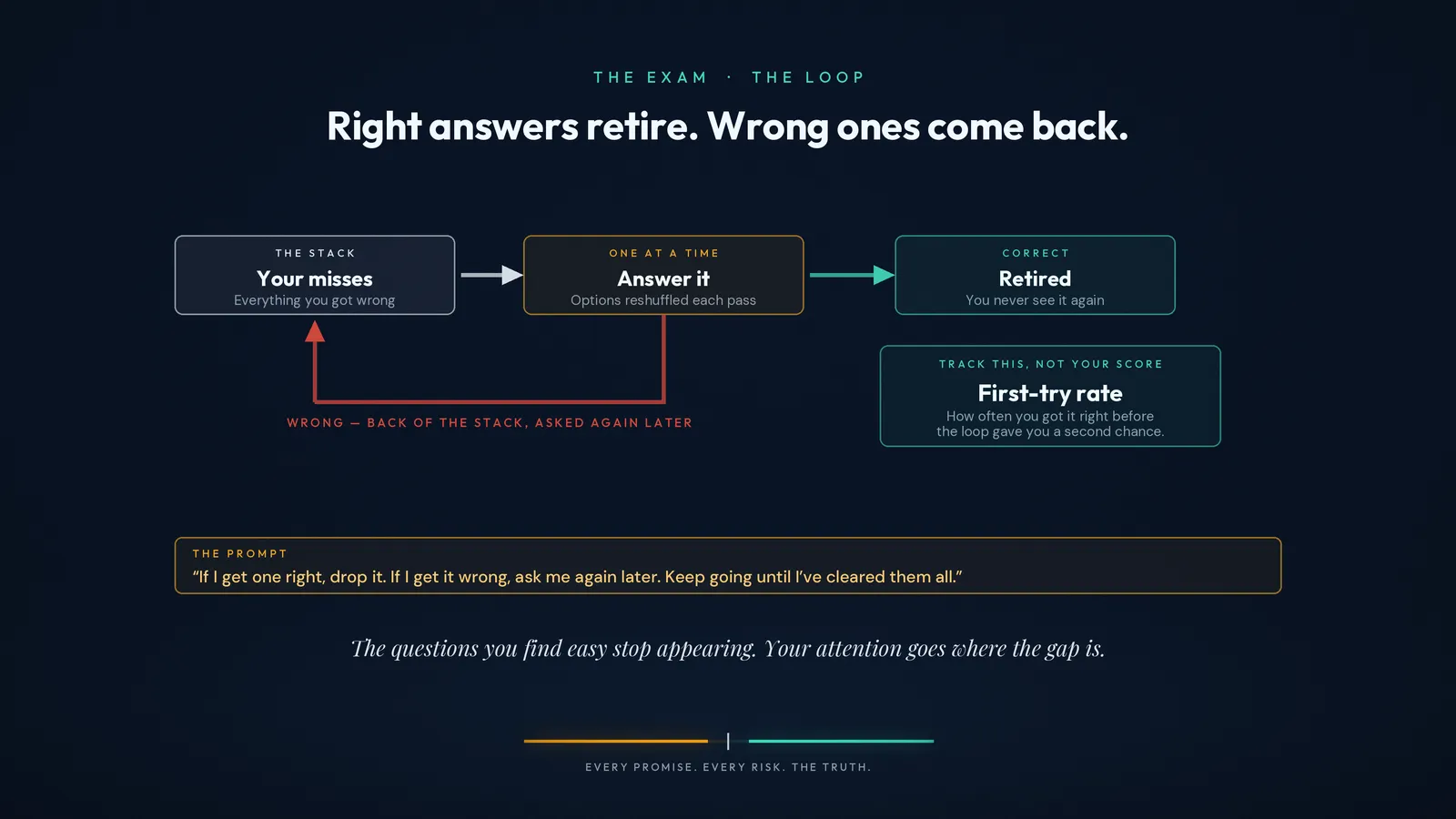
Here are the questions I got wrong. Ask me them one at a time. If I get one right, drop it. If I get it wrong, put it back in the rotation and ask me again later. Keep going until I've answered every one correctly at least once.
Track your first-try rate, not your score. At the end of a mastery loop your score is always 100% by construction. First-try rate is the honest number.
6 · Where it breaks
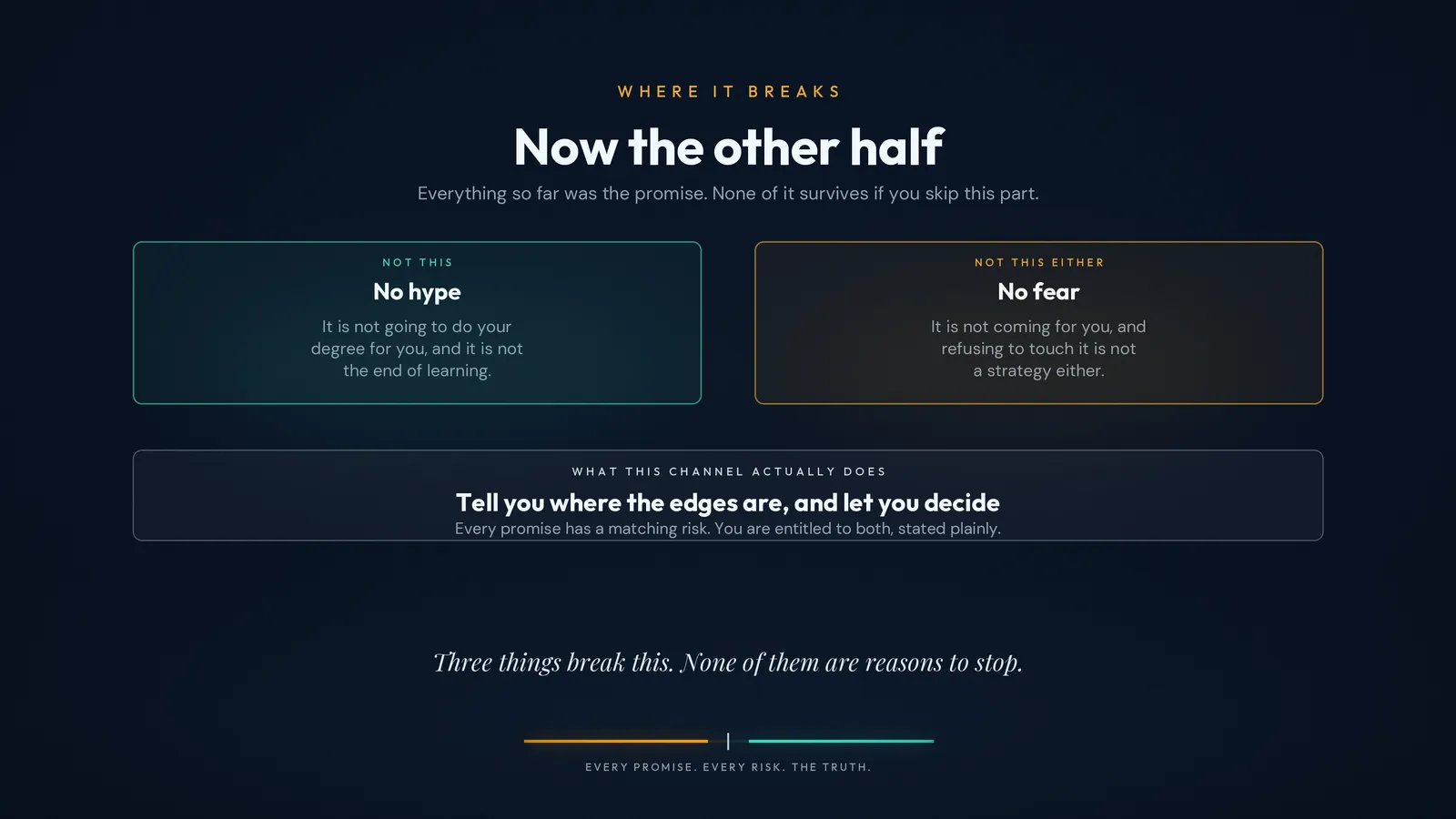
It is confidently wrong. The model produces a fluent, well-structured, entirely fabricated answer with exactly the same tone it uses when it is right. There is no signal in the delivery.
Fluency is mistaken for understanding. Reading a clear explanation feels like learning. It is not. If you have not retrieved it unaided, you do not have it.
The skill atrophies. Structuring an argument, holding a chronology, writing under time pressure — these degrade when they are outsourced, and the exam hall is where you find out.
The policy moves. Rules changed again this year, and they differ by faculty and by assignment. What was permitted last term may not be now.
Five rules
- Read your institution’s AI policy before term starts. Then load it into your tool so the rules travel with you.
- Use AI to find the conversation, never to replace reading it. Verify every source exists before you cite it.
- Write your thesis first, unaided. Then make the AI attack it.
- Make it ask, not answer. One sentence changes what the tool is for.
- Feed it your mistakes. The pattern is worth more than the corrections.
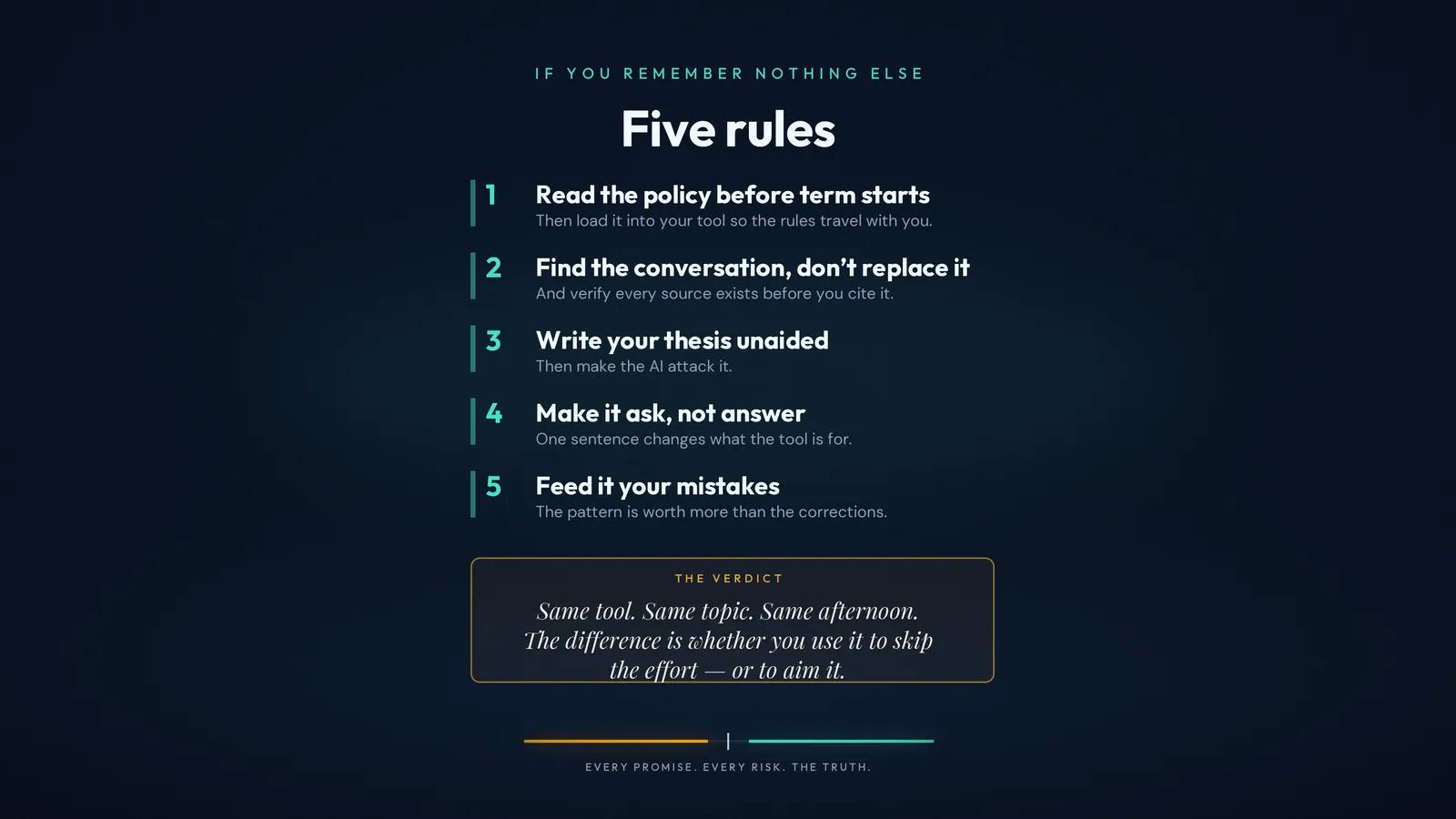
Same tool. Same topic. Same afternoon. The difference is whether you use it to skip the effort — or to aim it.
Every prompt, in one place
Copy-paste ready. Placeholders in square brackets.
Setting up
I'm pasting my institution's academic integrity policy on AI use. Remember it for everything we do this term. Before you answer any request from me, check it against this policy. If what I've asked for would breach it, tell me which section and stop.
Research
I'm writing an undergraduate essay on [topic]. Don't tell me the answer. Tell me what the major disagreements are, so I know what argument I'm walking into. For each school of interpretation, name the person most associated with it and the work I should read to check it myself.
For each source you just gave me, list only the author, the exact title, the publisher or journal, the year, and the ISBN or DOI. No description, no summary. I'm going to check every one of these in my library catalogue.
Here are my notes on [author]'s argument, in my words. I'm not asking you to improve them. Tell me what I've misunderstood, and what a specialist would say I've left out.
Summarize everything I've used you for in this conversation: what I asked, what you produced, and what I said I would verify myself. Format it as a dated log I can attach to my assignment as an AI-use declaration.
The essay
Here is my thesis: [paste your sentence]. You are an examiner who disagrees with it. Give me the three strongest objections, and name the evidence each one rests on.
Make the strongest possible case for [the interpretation you find least convincing], stronger than I could make it. Then make the strongest case against that view. Don't tell me which is right.
This is my essay structure. Don't rewrite it. Tell me where the argument jumps, which claim I haven't evidenced, and what a marker would push back on.
You're a student who hasn't studied this. I'm going to explain [topic]. Interrupt whenever I'm vague or skip a step, and ask the question a confused person would ask.
Formatting
Here are my [n] references. I have verified that every one of them exists and I have read them. Format them as an [style] reference list, alphabetized. Do not add any sources. Do not correct or complete any details — if something looks wrong or incomplete, flag it and leave it as it is.
Convert these footnotes from [style A] to [style B]. Don't change the content of any note, only the format.
My essay is [n] words and the limit is [n]. Show me which passages could go without losing any part of the argument. Don't rewrite anything and don't delete anything — point at what is cuttable and tell me what each cut would cost.
The exam
Here are my notes on [topic]. Ask me ten questions, one at a time. Don't give me the answer until I've tried. After each answer, tell me what I got wrong and why. Then ask the next one.
Give me the events of [sequence] in scrambled order. Ask me to place them in sequence and explain why each one made the next more likely. Don't confirm anything until I've committed to the full order.
Don't answer this. Ask me questions that help me work it out myself. Only tell me if I'm still stuck after three attempts.
Here are the [n] questions I got wrong on my practice paper. Don't correct them one by one. Tell me what mistake I keep making.
Based on that pattern, write me ten new questions that were not on the paper and that target exactly that weakness.
Here are the questions I got wrong. Ask me them one at a time. If I get one right, drop it. If I get it wrong, put it back in the rotation and ask me again later. Keep going until I've answered every one correctly at least once.